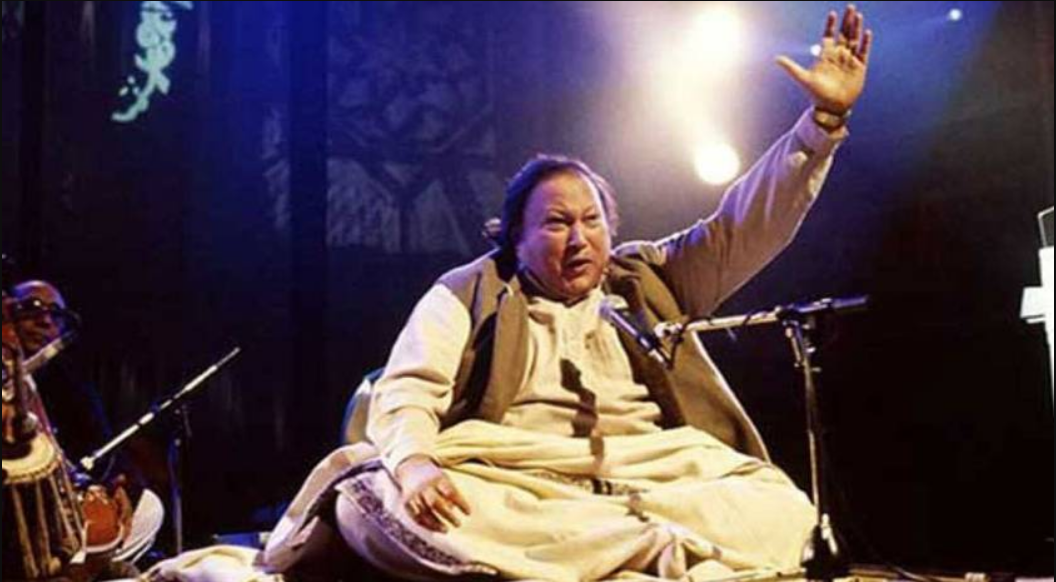

Nearly three decades after his passing, Ustad Nusrat Fateh Ali Khan continues to influence music across Pakistan and India. His compositions are being reinterpreted by contemporary artists, demonstrating that his work remains a living guide rather than a relic of memory.
One of the most recent examples is Meri Zindagi Hai Tu, a phrase immortalized by Nusrat in 1991. The original recording, uploaded to YouTube by Oriental Star Agencies Ltd, reached 14 million views over seven years. In November 2025, singer Asim Azhar released a drama OST inspired by the same refrain. Within two months, it had already crossed 30 million views on YouTube, with additional streams across Spotify and other platforms.
Similarly, Un Ka Andaz-E-Karam, a deeply spiritual qawwali written by Peer Naseeruddin Naseer and performed by Nusrat in 1991, continues to resonate. The original version accumulated 9.7 million views on OSA’s YouTube channel. In October 2025, Indian artists Madhur Sharma, Moin, ER, and Roheb released a cover under Universal Music India, which garnered 42 million views in under three months, introducing the composition to a digitally native audience.
Emerging artists like Havi (Abdur Rehman Sajid) have also drawn inspiration from Nusrat’s qawwalis. Havi’s performance of Andaz-e-Karam opens with a conversational line that immediately engages audiences before transitioning into the emotional heart of the song. His rendition, circulated widely across Instagram, Facebook, TikTok, and YouTube, has amassed over 6.7 million views, showcasing Nusrat’s enduring stylistic influence without direct imitation.
Another enduring example is Sanson Ki Mala Pe, first performed by Nusrat during his debut visit to India in 1979. Its earliest upload on OSA’s YouTube channel reached 22 million views over nine years. Subsequent versions by Rahat Fateh Ali Khan (106 million views), the Leo Twins (33 million views), and Vandana Sharma (18 million views) demonstrate the song’s continued relevance and the versatility of Nusrat’s influence.
These reinterpretations highlight that Nusrat’s music functions as a form of education for contemporary singers. Artists absorb his principles of emotional honesty, phrasing, and spiritual depth, rather than attempting direct replication. His compositions continue to teach emotional discipline, balance, and performance integrity across generations.
Nusrat Fateh Ali Khan passed away on August 16, 1997, in London at the age of 48 due to liver and kidney complications, culminating in sudden cardiac arrest. While his live performances ended, his global influence only expanded, helping Sufi devotional music reach new audiences.
Today, Nusrat’s legacy thrives through streaming platforms and modern reinterpretations. Each cover, new arrangement, or inspired refrain serves as proof that his work remains relevant. Younger artists may modernize the sound, but the emotional and spiritual core of his music remains intact. Nusrat Fateh Ali Khan continues to guide and elevate emerging singers, proving that some legacies do not fade—they find new voices to carry them forward.